How I Run a $30,000/Month Print-on-Demand Empire With Zero Inventory
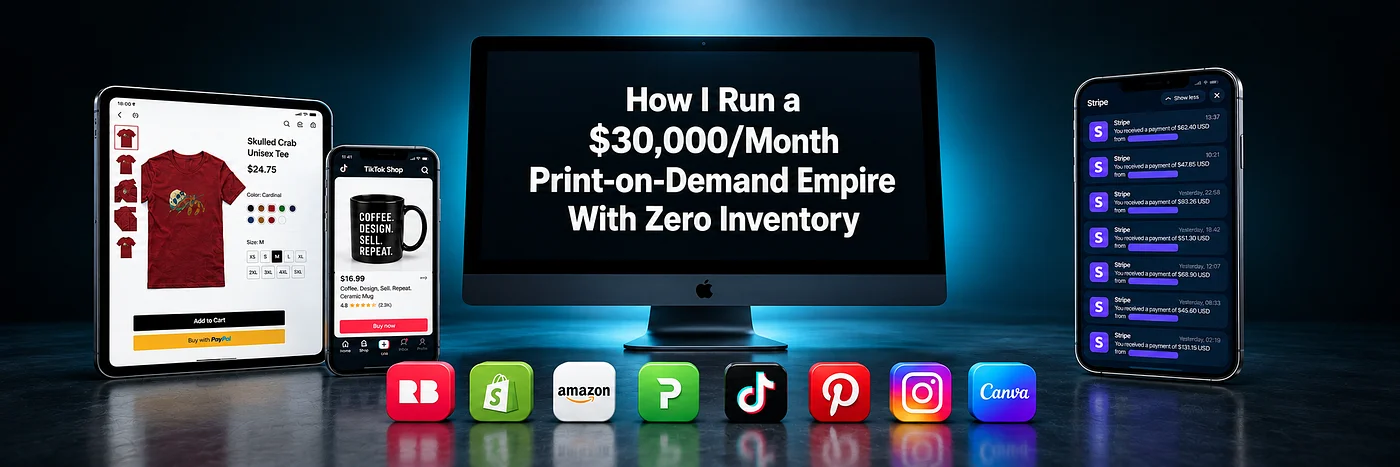
In a traditional physical products business, every dollar of profit is trapped in a warehouse.
You have to buy inventory in bulk, pay for shipping, gamble thousands of dollars upfront on designs you hope people like, and pray you do not end up with boxes of unsold stock sitting in your garage.
I completely refused to take that financial risk. I wanted a physical brand, but I wanted the economics of a digital business: zero upfront stock, zero shipping headaches, and zero warehouse fees. That is how I built a multi-channel print-on-demand operation that produces over $30,000 every single month without me ever touching a single product.
How the Manufacturing Engine Actually Works
Print-on-demand completely flips traditional manufacturing on its head. Products are produced only after a customer has already pulled out their credit card and paid for them.
When an order arrives on any of my connected storefronts, it routes automatically to a network of vetted print partners. They print the design directly onto the garment or product, package it, and ship it straight to the customer with a tracking number under my custom brand name.
The customer pays me full retail price. The base production cost is deducted automatically from the sale revenue, and the net profit lands directly in my bank account. I never pack an envelope. I never wait in line at the post office. I never deal with supply chain logistics.
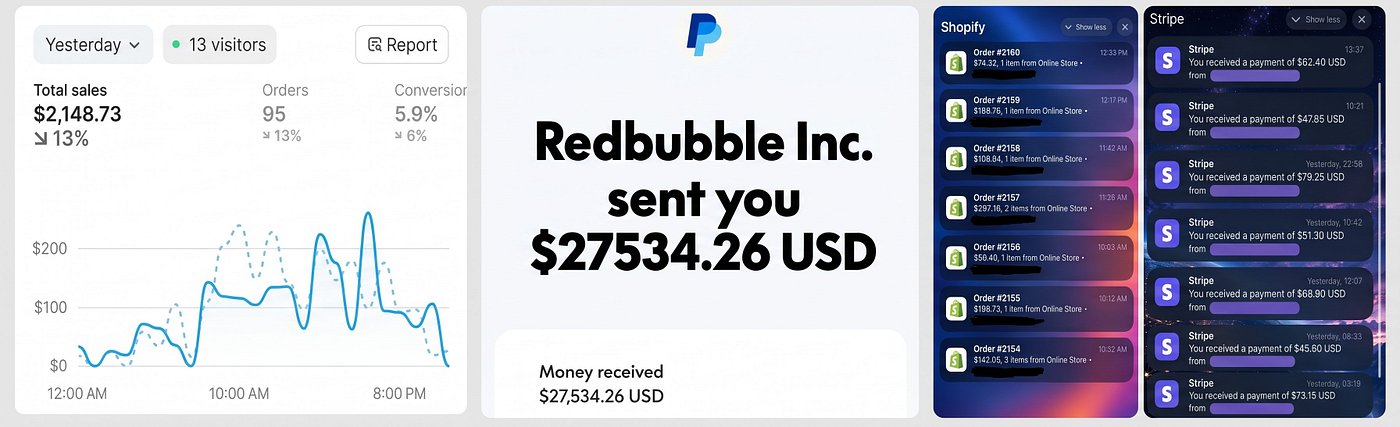
The Dual-Engine Strategy: Passive Marketplaces Meets a Private Brand
Most people get stuck earning a few hundred dollars a month because they only sell on a single platform. I run a hybrid system that stacks two distinct business models simultaneously.
- First, I deploy a passive marketplace machine. I syndicate designs across major global search marketplaces that already have millions of daily shoppers. A single design uploaded to these platforms is automatically mapped to dozens of different product types, from apparel and drinkware to phone cases and home decor. The marketplaces provide all the buyer traffic, handle customer service, and pay out monthly royalties. It requires zero ad spend.
- Second, I run an active brand model to capture premium profit margins. On passive marketplaces, royalties usually average 10% to 20%. But by running my own dedicated storefront connected directly to specialized manufacturing partners, I set my own retail pricing and pocket margins between 40% and 55%.
I connect this private production engine across high-traffic shopping channels, custom branded web stores, and social commerce platforms where shoppers purchase directly inside social feeds without ever opening a browser.
The AI Design Pipeline and Personalization Secret
I do not have a design degree, and I do not hire expensive design agencies. I use an AI production pipeline that turns market research into print-ready artwork in minutes.
Instead of targeting saturated generic terms, I target hyper-specific micro-niches. Smaller, passionate sub-audiences convert at dramatically higher rates because when they see the product, they feel an immediate emotional connection.
I use a specialized two-stack AI generation workflow. One tool handles crisp, perfectly rendered typography, while the other generates intricate, custom illustrative artwork. This allows me to produce dozens of commercial-grade assets in a single afternoon.
Then, I apply my biggest revenue multiplier: product personalization. A standard graphic tee or mug might sell for twenty dollars. But when you allow a customer to easily customize that design with a name, date, or personal milestone, the perceived value skyrockets. Average order values on personalized products jump to thirty-five or forty-five dollars, nearly doubling profit margins on the exact same physical blanks without requiring any manual graphic work on my part.
The Traps That Sink Most Beginners
While the business model is clean, running into operational traps will destroy your margins fast.
- The first mistake is ignoring strict technical file standards. Print manufacturing demands precise specifications. If your designs are not rendered at high-resolution print standards on clean transparent backgrounds with the correct digital color profiles, the final print will look blurry or discolored on dark fabrics, triggering immediate refund requests and customer complaints.
- The second trap is missing the seasonal retail calendar. In the physical product world, the final three months of the year can account for up to 60% of your annual earnings due to holiday gift shopping. If you wait until November to upload holiday designs, marketplace algorithms will not have enough time to index your listings, and you will completely miss the tidal wave of seasonal sales.
- Finally, trying to manually manage dozens of storefronts without an automated syndication system turns what should be a passive asset into a chaotic, full-time administrative job.
The Shortcut to $30K/Month
Instead of spending years testing print providers, making costly technical design errors, or guessing which niches have buying customers, I packaged my complete production and scaling roadmap into a single blueprint.
This system hands you the exact micro-niche validation process and the two-stack AI design toolkit to create print-ready graphics rapidly. It reveals how to launch your own branded storefront with a custom domain for under fifteen dollars, how to integrate your products across ten sales channels simultaneously, and the exact production timeline to maximize the lucrative holiday gift surge.
You do not need storage space, expensive equipment, or upfront inventory risk. You just need the right distribution system.