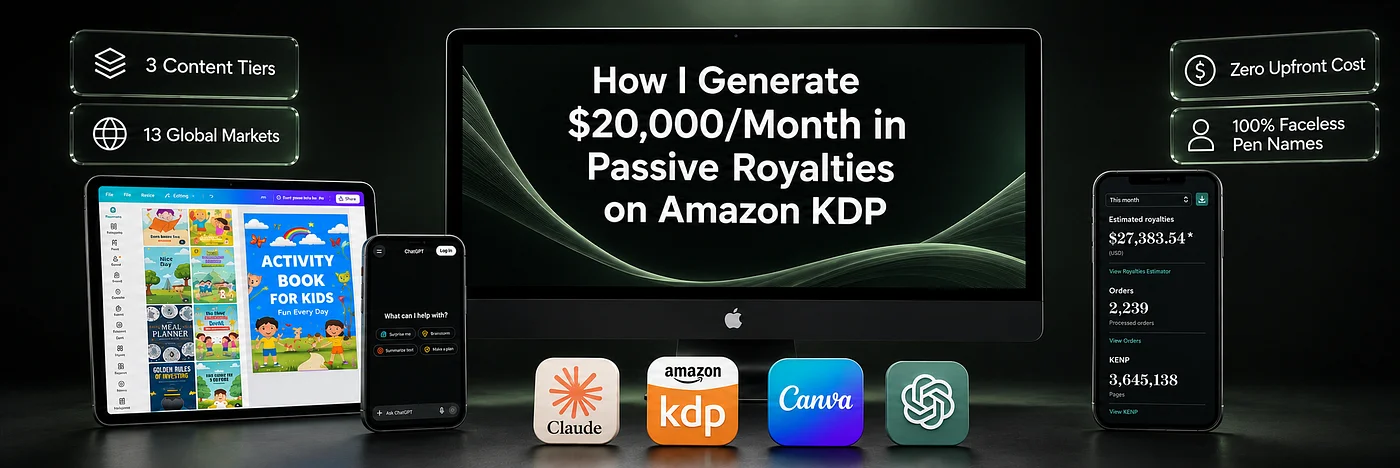
How I Generate $20,000/Month in Passive Royalties on Amazon KDP
Every other digital business model forces you to build an audience first. You have to post content daily on Instagram, battle algorithms on Threads, or record videos for TikTok for months before a single dollar hits your bank account.
Amazon KDP works in reverse. When you publish a book on Amazon, you are instantly connected to over 300 million active buyers across 13 global marketplaces. You do not have to generate the traffic because it already exists. People are logging into Amazon every second with their credit cards already saved, searching for books to solve their problems or entertain them. Your only job is to show up in front of that search demand.
A book I published twelve months ago still earns royalties every week in the US, the UK, and Germany without me touching it. It is the closest thing to true passive income on the internet.
The Three-Tier Catalog Architecture
Most beginners fail because they think KDP is just about publishing low-content blank journals. They upload fifty generic notebooks, make three sales, and give up.
To build a catalog that generates $20,000 a month, I stack three distinct content tiers:
-
Tier 1: Low-Content Products. Puzzle books, activity books, and niche-specific logbooks. These require zero writing and take an afternoon to design using Canva and free interior generators. They produce fast volume and quick baseline cash flow.
-
Tier 2: Medium-Content Workbooks. These contain real, structured value, such as guided finance workbooks, habit guides, or niche recipe collections. Because each page contains unique content, they raise the quality floor, eliminate spam competition, and command higher retail prices.
-
Tier 3: High-Content Nonfiction Series. Complete, practical guides between 25,000 and 40,000 words. Nonfiction books solve expensive problems. Readers buy the entire series, and each title continues to rank for years.
On top of direct book sales, enrolling in KDP Select unlocks Kindle Unlimited page reads. When a subscriber reads through a 300-page book in my catalog, Amazon pays me roughly $1.35 in passive page-read royalties. Across a 50-book catalog, those accumulated page reads generate $6,000 to $8,000 every single month before factoring in a single direct paperback sale.
The Mechanics of Amazon Search Engine Optimization
You do not need to be a famous author to hit page one on Amazon. Amazon's algorithm, called A9, only cares about matching a buyer's exact search intent to a product that converts.
My entire distribution relies on three mechanical levers:
-
The Title Formula: Amazon weights the book title more heavily than any other metadata field. I never use clever or artistic titles. I use the exact keyword phrase buyers type into the search bar, followed by a subtitle packed with secondary search terms.
-
The 7 Backend Keyword Slots: KDP gives you 7 keyword fields during upload, each holding up to 50 characters. Most publishers waste these with single words or repeat words from their title. I fill all 50 characters of every slot with long-tail buyer search phrases, instantly indexing each book for hundreds of search variations.
-
Low-Competition Category Placement: Instead of placing a book in a broad category where it gets buried, I target specific sub-categories with lower sales thresholds. This lets the book quickly claim an orange #1 Bestseller badge, which drastically increases click-through rates and signals Amazon to push the listing organically.
For production, I use AI to compress months of work into days. I use Claude to research buyer psychology and draft outlines, Ideogram to create covers with crisp typography, and Reedsy Studio to export clean, print-ready interior files.
The Brutal Reality of Doing It Wrong
The opportunity on Amazon is massive, but executing blindly will destroy your account.
The most common trap is dumping unedited AI output onto the platform. Buyers in 2026 recognize lazy AI writing instantly. They leave harsh 1-star reviews calling out repetitive phrasing and factual errors, which tanks your ranking permanently.
The second trap is technical formatting. Amazon has rigid specifications for print margins, gutter sizes, bleed settings, and spine widths. If you get your page count calculations wrong, your physical paperbacks will print with cut-off text or misaligned spines, triggering returns and negative reviews.
Finally, ignoring Amazon's strict AI disclosure rules or misrepresenting content can get your KDP account permanently banned.
The Shortcut to $20K/Month
Instead of spending months making publishing mistakes or guessing which niches have buyers, I documented my entire publishing architecture into a repeatable blueprint.
This blueprint hands you the exact 6-phase AI writing workflow that turns validated niches into upload-ready nonfiction manuscripts in weeks. It includes my complete editing checklist to ensure your books read professionally and earn 5-star reviews. You get the exact formulas to maximize all 7 backend keyword slots, the blueprint to structure multi-book series for maximum readthrough, and the step-by-step roadmap to scale a catalog to $20,000 a month in passive royalties.
You do not need to be a professional writer. You just need to build a catalog that answers existing search demand.